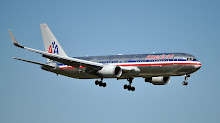
A trip I flew to Haiti, "Third World Operations", was worthy of a post way back in early December.
That was the last time I had been back to Haiti until just recently. My employer has resumed service back into Port-au-Prince and I had the opportunity to re-visit PAP on a recent trip.
My first officer that day was new to PAP so I would be the tour guide. Our preflight duties included a complete review of the temporary restrictions governing commercial aircraft operations in and out of Haiti. We were carrying a complete packet of the latest procedures, communications frequencies, arrival and departure profiles, parking instructions, and anything else relevant to the airport. We were departing Miami in a fully loaded 767.... 223 passengers and a crew of 13.
Shortly after the quake, the United States came in to provide air traffic control services as well as medical and humanitarian aid on a massive scale. The US has been slowly returning ATC control back to the Haitians and today we were in Haitian controllers hands. That would prove to be a detriment to our goal of operating a uneventful flight! We launched from MIA behind an arriving World Airways MD-11 and climbed eastbound across the Bahamas chain.
It was business as usual until we had to switch over to Port-au-Prince tower.
Descending in, we were cleared for an ILS to runway 10 with a circle to land on runway 28. But we were only given a clearance to descend to 5000 ft and to report inbound on the ILS. OK fine...So we continued on in and reported inbound but the controller was apparently too busy or distracted to hear us. We kept calling until he finally answered us and asked where we were? "We're overhead the field at 5000 ft" was our answer! He seemed surprised and promptly cleared us back to the initial approach fix and gave us instructions to hold and await further clearance.
20 minutes later he cleared us for the same approach and for us to call the field in sight and to enter a downwind for runway 28. So we did all that and set up for the landing. Meanwhile he cleared a Canadian Air Force C-17 to back-taxi for takeoff on runway 28. As we turned final, the tower amended the C-17's enroute clearance which resulted in them not being ready for takeoff. With us now on short final and the C-17 still on the runway, we had to execute a go-around and get back in the pattern.
So now we're back on final and the tower has cleared the C-17 for takeoff. It all was looking good until the C-17 aborted their takeoff with some sort of mechanical issue. We had no choice....another go-around!! We broke off to the right and started a climb. Just then we received a traffic alert on our TCAS with instructions to "CLIMB, CLIMB". I looked out and saw a Cessna Caravan doing a steep turn to avoid us as we were climbing and turning in the other direction. That was close! We asked the tower for instructions and all he could tell us was "go hold east of the airport somewhere". He was completely flustered and not in control of his airspace. Now a clearance like that in the real world is just unheard of! We were clearly on our own this day.
After several minutes of us circling low over the city, he told us to come on in and land. By then we had lost sight of the airport so we had to rely on some basic VFR skills and dead reckoning to re-acquire the airport.
The third time was a charm and we actually made a landing.
Taxiing in we could see the massive amounts of relief supplies and equipment all over the airport. It must have been a huge undertaking getting all these supplies in right after the quake.
 They even brought in a temporary control tower since the PAP tower was destroyed.
Sorry that it's blurry. On the bright side, we were able to use a jet bridge and keep our passengers off of the ramp area like in the past.
After the First Officer and I finished the parking checklist we just looked at each other in disbelief and breathed a sigh of relief. That was a flight to remember!
So off with 223 passengers and on with 223 more heading back to Miami.
The takeoff and climb went smoothly. Climbing out over the bay we could see several US Navy ships anchored. Two of them were Landing Helicopter Assault ships that were helping with the relief effort. It will most likely be years before Haiti gets back on it's feet after such a disaster. But the recovery goes on and life is very slowly returning to Port-au-Prince.
 Two hours later we were on final to runway 30 at Miami.
Once again it was nice to be back in US airspace.
For a look at some more of my photos, please aviate over to Plane & Simple.
Saturday, March 20, 2010
Port-au-Prince (After The Quake)


Wednesday, November 5, 2008
The 757...very nice!
One of the benefits of being rated on the 767 is that the rating also qualifies the pilot for the 757 as well. It is a common type rating...meaning that the airplanes have enough similar flight characteristics so that a single rating is all that is required. The engines are different as are a few of the systems and some of the limitations are different as well, but the airplanes essentially fly the same and the transition between the two is very easy.
 The 757 is an absolute joy to fly. Even though the pay scales are slightly lower than the 767, I don't know any of our pilots that don't enjoy flying it. It handles like a sports car as opposed to the 767 which handles like a big luxury car.
At AA, our domestic and international divisions include 767 and 757 flying co-mingled.
AA purchased their 757's with Rolls Royce engines. They produce almost 43,000 pounds of thrust apiece. Maximum takeoff weight is 250,000 pounds and max landing weight is 198,000 pounds. Maximum operating altitude is 42,000 feet.
When AA purchased TWA in 2001, their 757 fleet was integrated into ours, but they have since gone away. They all had Pratt & Whitney engines and were slightly incompatible with the AA fleet. Many of them are now being operated by Delta Air Lines.
So with all that being said, the day's trip would be from Ft Lauderdale over to Port-au-Prince, Haiti, back to FLL and then on to DFW. Our 757 was lightly loaded with passengers but heavy on fuel. We were carrying enough fuel for the return leg as well. Apparently since Hurricane Ike hit Haiti, fuel has been in short supply so the airlines are tankering in their fuel.
Also since the hurricane, radar coverage is non-existent. We would be making mandatory position reports and flying a full DME-ARC approach to the airport even though weather conditions were fine. We checked in with Port-au-Prince Control and started our descent over the northwest part of the island. There was no traffic inbound but they still cleared us for the full approach even though we had the field in sight about twenty miles out.
 The DME-ARC led us to a straight in landing over the Gulf of Gonave and a taxi in to our parking spot. No jet bridge today. The few jet bridges there were not working.
 During our short stay we saw several UN helicopters delivering humanitarian supplies throughout the island.
Sixty minutes later we were on our way back to Florida. Port-au-Prince cleared us directly up to flight level 400. It took just over 20 minutes. No time to climb record today like Darren but still respectable for an airliner.
The Bahamian island chain passed below and soon we were over the island of Bimini and descending for FLL. As nicely as the 757 flies, the landings are just as easy. Or at least that's what all the First Officers that I have been flying with have shown me. The FO today greased it on 9L at FLL. I have yet to plant a 757 on the runway but I'm sure the day is coming. I have already done so in a 767 so that square is filled.
My leg back to DFW and still no hard landing! What a nice airplane!
For a look at some more of my photos, please aviate over to Plane & Simple.